Srixon didn’t need to reinvent the ZXi iron. It needed to find ways to make an already dominant platform better, and add something the lineup was missing.
That is what makes the new Srixon ZXi family interesting.
The ZXi 5 and ZXi 7 were already two irons we saw perform exceptionally well in the fitting bay. For 2026, Srixon has refined both rather than completely changing what made them successful. But perhaps the biggest story is the addition of the ZXi 5+: a new model that brings more speed and distance into a shape that still looks and feels unmistakably Srixon.
At Cool Clubs, we wanted to look beyond the product story and understand what has actually changed. We 3D scanned the heads, measured the specifications and robot tested the new ZXi 7, ZXi 5 and ZXi 5+ at 80 mph, including center strikes and multiple impact locations.
The results show three distinctly different performance windows, and some meaningful improvements over the previous generation.
Meet the New ZXi Family
The easiest way to understand the lineup is as a progression:
| ZXi 7 | ZXi 5 | ZXi 5+ | |
| Loft | 32 Deg. | 31 Deg. | 29.5 Deg. |
| Ball Speed | 108.0 MPH | 109.6 MPH | 111.0 MPH |
| Launch | 22.1 Deg. | 22.6 Deg. | 20.9 Deg. |
| Spin | 5,333 RPM | 4,852 RPM | 4,525 RPM |
| Carry | 156.0 Yds | 161.0 Yds | 165.4 Yds |
| Peak Height | 94.4 Ft | 99.2 Ft | 93.4 Ft |
| Descent | 46.4 Deg. | 46.8 Deg. | 44.9 Deg. |
All three were robot-tested at essentially the same 80 mph club speed, giving us a particularly clean look at how the three heads separate.
And they separate exactly where you would hope.
The ZXi 7 prioritizes spin and control. The ZXi 5 sits in the middle with an impressive combination of speed, launch, height and stopping power. The new ZXi 5+ moves firmly toward speed and distance, producing the highest ball speed and longest carry of the three.
That makes the 5+ far more than another cosmetic variation of an existing model.
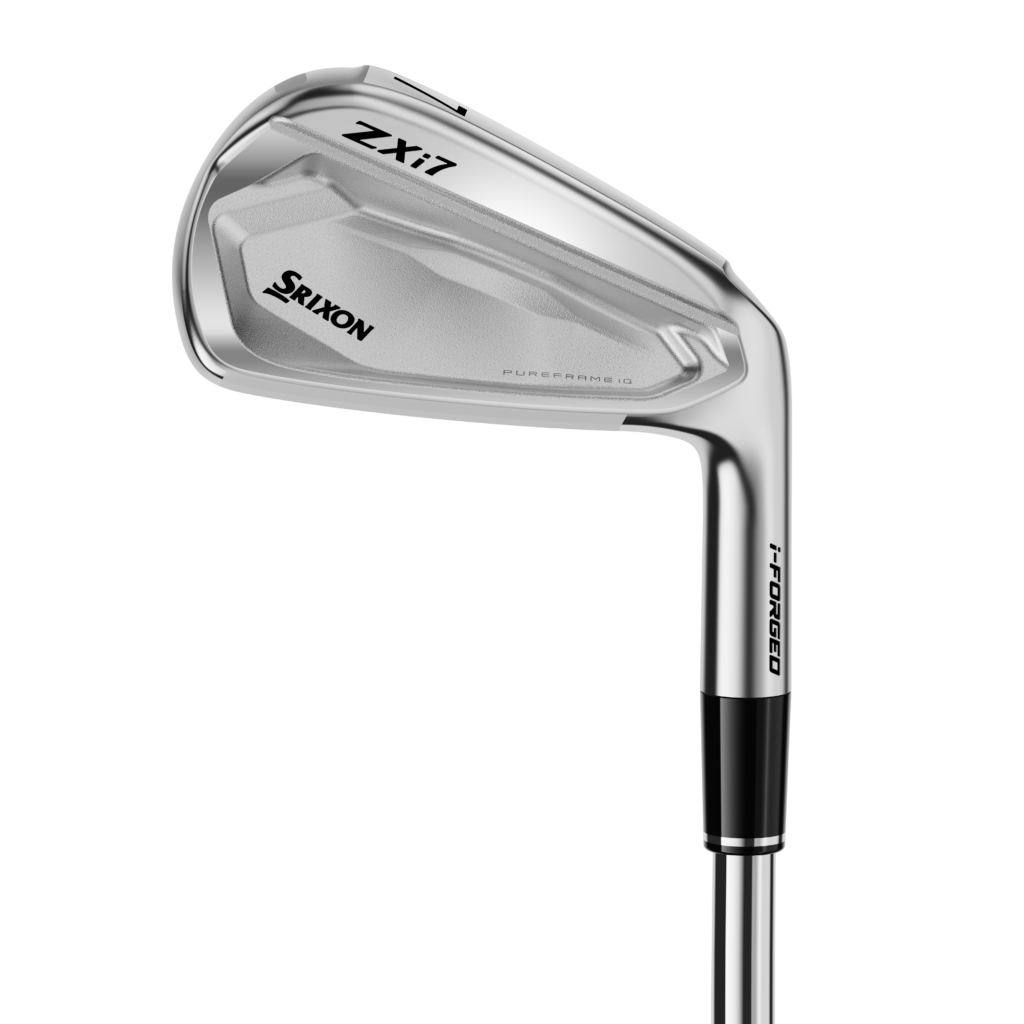
ZXi 7: More Refined, More Compact, More Controlled
The ZXi 7 was already a great players iron, so Srixon’s changes are relatively subtle — but our measurements show they are meaningful.
The new model retains its 32° loft, but the topline has been reduced from 0.206″ to 0.192″ and blade length shortened from 73.95 mm to 73.1 mm. The overall footprint has also decreased slightly, while bounce increased from 7.4° to 8.1°.
That should be noticeable to the golfer standing over it.
It’s a slightly tighter, cleaner package that leans further into what the ZXi 7 golfer is likely looking for.
And the robot data tells an equally interesting story.
Against the previous ZXi 7, center-impact testing showed:
+0.8° Launch
+250 rpm spin
+3.1 ft peak height
2.1 yards less carry
Rather than chasing additional distance, the performance has moved toward launch, spin and control.
That makes sense for this category.
But arguably the bigger result came when we moved away from center.
ZXi 7 dispersion improved by 23%.
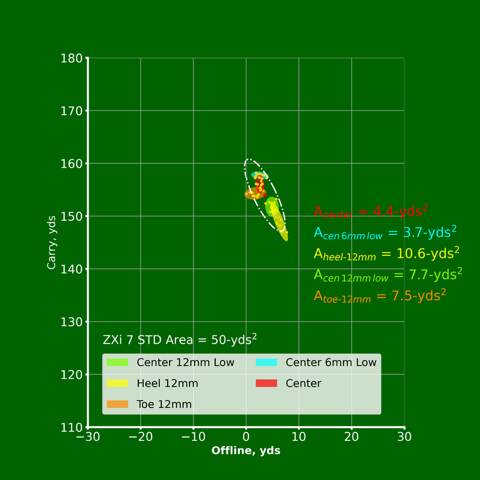
Our overall robot dispersion footprint dropped from 65 square yards to 50 square yards — a 23% reduction.
That’s a compelling combination: a more compact players shape with a significantly tighter overall dispersion pattern in our testing.
ZXi 5: The All-Rounder Got Even Better
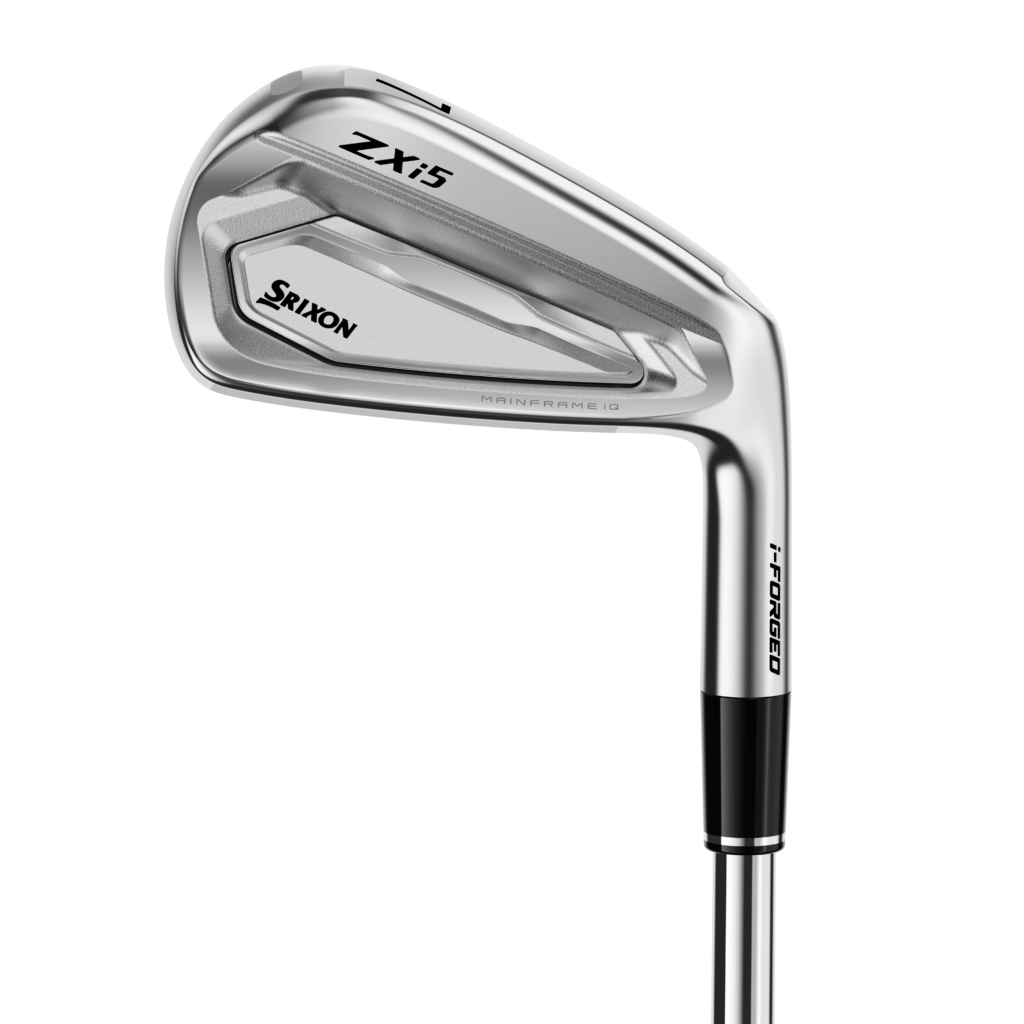
If there is one iron in the lineup that illustrates how small engineering changes can produce meaningful performance changes, it’s the ZXi 5.
At first glance, its dimensions haven’t changed dramatically.
Loft remains 31°. But Srixon reduced the offset from 0.138″ to 0.126″, slightly reduced the overall footprint and increased bounce from 7.1° to 8.4°.
Visually, that helps preserve the clean appearance golfers expect from the ZXi family while refining the package.
Performance is where things get particularly interesting.
Same loft. More speed. More carry.
Compared with the previous ZXi 5 at identical robot speed, the 2026 model produced:
+1.1 mph ball speed
+0.02 efficiency
+0.6° launch
+5.4 ft peak height
+4.1 yards carry
Spin decreased by 314 rpm, but the ball still launched higher and reached a greater peak height.
That’s a pretty impressive evolution from a club whose loft hasn’t changed.
The new ZXi 5 carried 160.9 yards versus 156.8 for the previous model in our center-strike robot comparison.
And once again, the dispersion story may be even more important.
Overall dispersion tightened 22%.
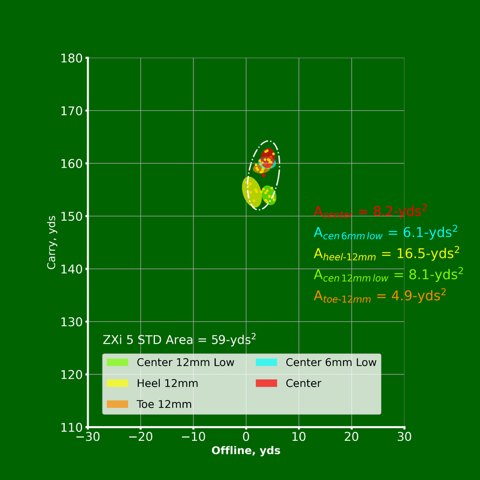
The previous ZXi 5 produced a 76-square-yard overall dispersion footprint in our testing.
The new model: 59 square yards.
That’s a 22% reduction.
So we’re seeing more center-strike speed and distance while simultaneously seeing a tighter overall pattern across the tested strike locations.
That’s a very strong combination for a fitting iron.
ZXi 5+: The Iron That Could Become the Star of the Lineup
This is the club we think golfers, and fitters, should pay particularly close attention to.
The ZXi 5+ creates a new performance option within the ZXi family.
It offers the visual DNA and premium appearance of the ZXi line but pushes performance toward a faster, longer category.
And the numbers make its position obvious.
At approximately 80 mph:
111.0 mph ball speed
1.39 efficiency
20.9° launch
4,525 rpm spin
165.4-yard carry
178.7-yard total
It was both the fastest and longest of the three new irons in our center-strike test.
But what’s particularly interesting is how Srixon got there.
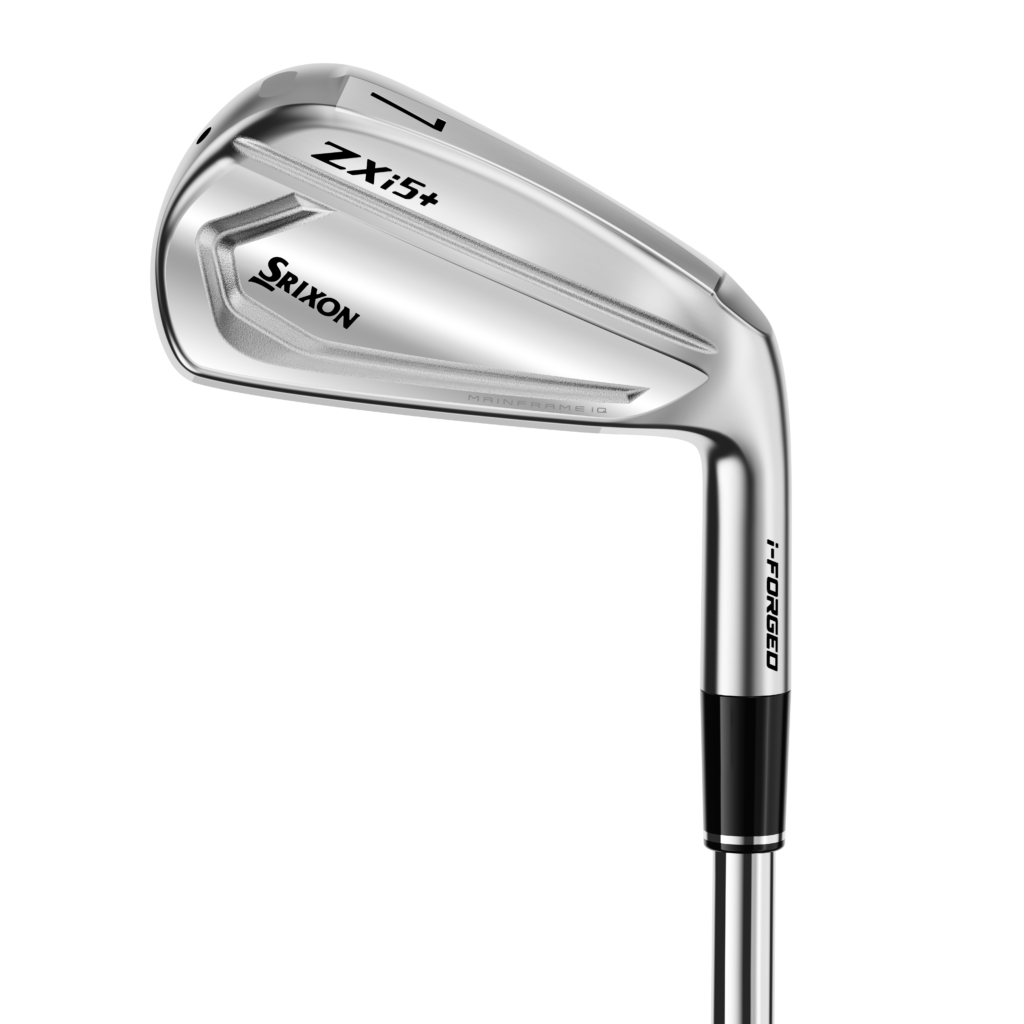
The ZXi 5+ Isn’t Simply a ZXi 4 With a New Name
Using the previous ZXi 4 as the closest comparison makes the design change clear.
The ZXi 5+ is actually one degree weaker at 29.5° versus the ZXi 4’s 28.5°.
Yet the head is considerably more compact.
Its topline drops from 0.249″ to 0.203″, its footprint falls from 1,301 mm² to 1,230 mm², and its blade length decreases from 76.82 mm to 76.2 mm. Offset does increase from 0.115″ to 0.139″.
So visually, the story isn’t simply “make the loft stronger and make the head bigger.”
In fact, it’s almost the opposite.
Srixon has created a smaller, cleaner package with one degree more loft, while maintaining the center-strike speed and distance of the ZXi 4.
The robot numbers reinforce that.
Compared with ZXi 4, the ZXi 5+ produced essentially identical ball speed and efficiency, but launched 0.8° higher, spun 233 rpm more and peaked 5.5 feet higher. Carry changed by only 0.3 yards.
That’s important.
The ZXi 5+ isn’t gaining its performance by simply strengthening the loft.
It produced essentially the same center-strike distance as the stronger-lofted ZXi 4 while creating a higher launch, more spin and greater peak height.
For fitting, that’s a very interesting performance window.
What Happens When You Miss the Center?
Center performance only tells part of the story.
Our robot testing also moved impact around the face to understand how each model responds when contact isn’t perfect.
And there are two different stories here.
The ZXi 5 and ZXi 7 both produced substantially tighter overall dispersion footprints than their previous-generation counterparts — improvements of 22% and 23%, respectively.
The ZXi 5+ was different.
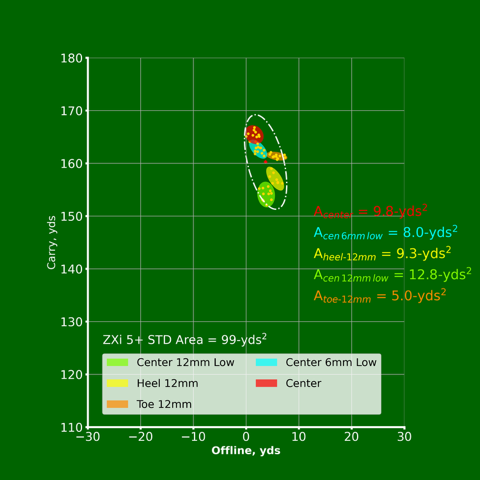
Compared with the previous ZXi 4, overall dispersion area increased from 80 to 99 square yards, a 24% increase in this particular robot test.
That is worth highlighting rather than hiding.
The ZXi 5+ isn’t “more forgiving than the ZXi 4” across every measurement. It’s a different design proposition: substantially more compact visually, while maintaining impressive center-strike speed and creating a different launch window.
And that’s exactly why fitting matters.
Carry Retention on Mishits
Looking specifically at carry change relative to the center strike gives another perspective.
| Impact Location | ZXi 7 | ZXi 5 | ZXi 5+ |
| 6 mm Low | + 1.7 yds | – 0.9 yds | – 2.7 yds |
| 12 mm Low | – 4.3 yds | – 7.1 yds | – 11.3 yds |
| 12 mm Toe | – 1.7 yds | – 2.0 yds | – 4.1 yds |
| 12 mm Heel | – 7.0 yds | – 6.5 yds | – 8.3 yds |
This adds some context to the models’ different personalities.
The ZXi 7 was particularly impressive in maintaining carry on the low and toe strikes in this test. The ZXi 5 remained a strong middle ground, while the faster ZXi 5+ gave up more distance as impact moved significantly away from center.
So there’s a trade-off.
The 5+ gives you the highest speed ceiling. The 5 and 7 showed stronger overall consistency in this robot test.
For a fitter, that’s useful information rather than a weakness. Different golfers need different things.
Three Irons, Three Clear Performance Windows
Perhaps the best thing about the new lineup is that the models aren’t fighting each other.
ZXi 7 — Control
The highest-spin model at 5,333 rpm, with 46.4° descent and excellent carry retention on several mishit locations. Its new shape is also more compact, with a thinner topline and shorter blade.
This is the golfer who wants the players look and greater control without giving up the technology available in a modern iron.
ZXi 5 — Balance
This may be the sweet spot.
It produced the highest launch (22.6°), highest peak (99.2 ft), and steepest descent (46.8°) while still carrying 161 yards.
Add the 22% tighter overall dispersion footprint compared with its predecessor, and the ZXi 5 becomes a very complete package.
ZXi 5+ — Speed
This is the new category for Srixon.
At 111 mph ball speed and 165.4 yards carry, the 5+ clearly separated itself from the other two for raw distance.
For a golfer who wants speed but doesn’t necessarily want the visual package traditionally associated with a distance iron, this could be an extremely interesting fitting option.
The Five Biggest Takeaways From Our Testing
1. The ZXi 5+ could be the biggest story in the entire lineup.
Srixon has created a genuine bridge between its traditional players-distance irons and the faster end of the market. It produced the most ball speed and distance in our test while maintaining the visual language of the ZXi family.
The fitting-bay question: How many golfers want distance-iron performance without looking down at a traditional distance iron?
We suspect quite a few.
2. The ZXi 5 improved without getting stronger.
This is one of our favorite numbers from the test.
31° before. 31° now.
Yet ball speed increased 1.1 mph and center carry increased 4.1 yards.
That’s a much more interesting technology story than simply strengthening loft.
3. Srixon appears to have prioritized control in the ZXi 7.
The new ZXi 7 didn’t get longer in our center test — it actually carried two yards shorter.
But it launched higher, spun 250 rpm more and produced a 23% tighter overall dispersion footprint.
For the golfer this iron is designed for, that could be exactly the right trade.
4. The ZXi 5 might still be the hardest iron in the family to beat.
The 5+ will understandably get attention for its speed, but look at the complete ZXi 5 window:
22.6° launch. 4,852 rpm spin. 99.2 ft peak. 46.8° descent. 161-yard carry.
It sits almost perfectly between the control of the 7 and speed of the 5+.
For a huge range of golfers, that combination could make it extremely difficult to beat in a fitting.
5. Combo sets just became even more interesting.
This may ultimately be the most important fitting takeaway.
You no longer necessarily have to choose one model.
A player could favor the ZXi 7 where precision and spin matter most, transition into ZXi 5 through the middle of the set, and potentially use the ZXi 5+ where additional speed and distance become more valuable.
The three performance windows are separated enough that the lineup gives a fitter real tools to solve different problems throughout the bag.
Final Thoughts
Improving a bad product is easy. Improving a great one is much harder.
That’s what makes this Srixon release compelling.
The ZXi 5 and ZXi 7 weren’t irons desperately waiting for replacement. They were already extremely impressive products. Instead of changing them simply for the sake of having something new, the 2026 data suggests Srixon has made targeted changes.
The ZXi 7 is more compact and produced tighter overall dispersion in our test.
The ZXi 5 gained speed and distance at the same loft while also tightening its overall dispersion.
And the ZXi 5+ creates an entirely new option — bringing 111 mph ball speed and 165-yard carry at our 80 mph robot speed into a considerably more compact package than the previous ZXi 4 comparison.
That last club could be the wildcard.
We believe the ZXi 5+ has the ingredients to become one of the most relevant irons in the fitting bay through the rest of 2026 and into 2027 — particularly for the golfer who wants additional speed and distance but doesn’t want to sacrifice the look and feel that drew them to Srixon in the first place.
And ultimately, that’s the strength of the new family.
ZXi 7 for control. ZXi 5 for balance. ZXi 5+ for speed.
Three different performance windows. One unmistakably Srixon iron family.
The Data
ZXi 5+
ZXi 5
ZXi7