The new Srixon ZXi RKT driver family had to do more than look good to earn a place in the Cool Clubs fitting matrix. After extensive robot testing, 3D analysis and hitting-bay evaluation, all three did exactly that.
Srixon has steadily built a reputation for producing exceptional equipment, but the new ZXi RKT driver family feels like another significant step.
For 2026, there are three distinct options: RKT LS, RKT and RKT MAX. They share an exceptionally clean aesthetic and a common design language, but underneath, they are three very different fitting tools.
At Cool Clubs, that distinction matters.
We don’t add a driver to our fitting matrix simply because it’s new. It has to offer something that helps our fitters solve a problem for a golfer. So we put the new RKT family through the same process we use to understand every major new product: robot testing across multiple impact locations, head measurement and analysis, and real-world hitting-bay testing.
The result?
All three RKT models have earned their place in the Cool Clubs fitting matrix.
And when you dig into the data, it’s easy to understand why.
Three Drivers. Three Very Different Jobs.
The beauty of the RKT lineup is that Srixon hasn’t tried to make three slightly different versions of the same driver.
Each head has a clear purpose.
ZXi RKT LS – Low Spin With Front-to-Back CG Control
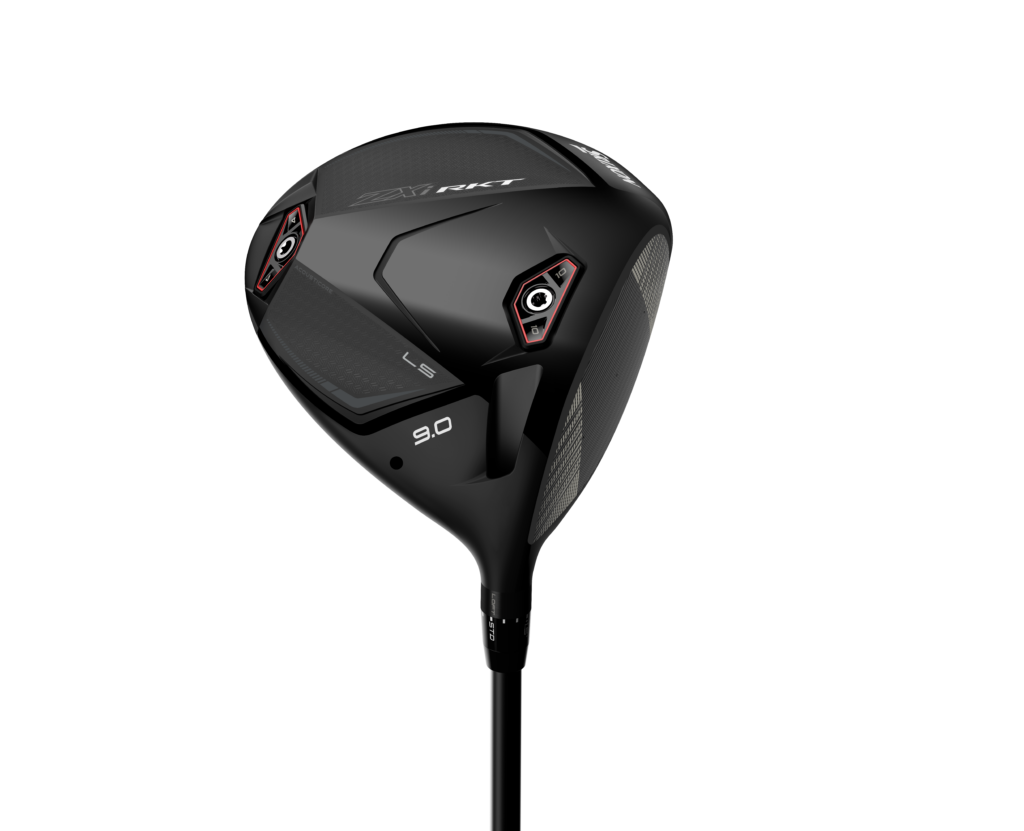
The RKT LS is the lowest-spin option and gives the fitter the ability to manipulate CG front to back.
That creates an important fitting lever. For a golfer producing too much spin, delivering too much dynamic loft or simply looking for a more penetrating flight, the LS gives us an opportunity to optimize launch and spin without treating the head as a fixed product.
Our measurements reinforce just how different this head is from the other two. The RKT LS measured at 4,435 MOI with a 0.65-inch CG depth, the shallowest CG of the family. Interestingly, MOI is actually 4.5% lower than the previous ZXi LS, suggesting Srixon has been willing to sacrifice some absolute stability to create the performance characteristics it wants from this head.
And the robot results were impressive.
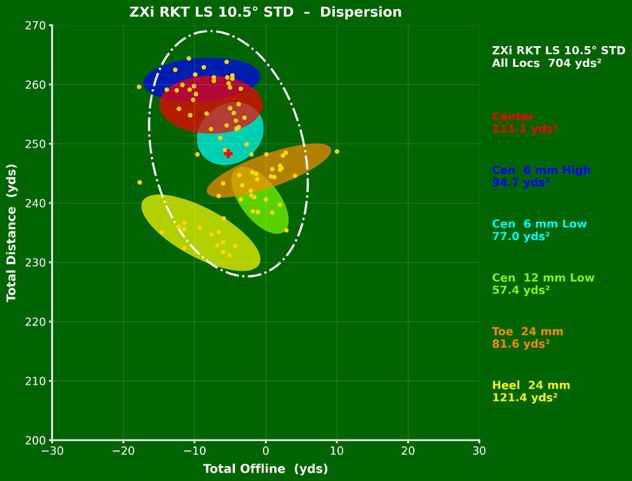
At 95 mph on a true-center strike, RKT LS produced 139.3 mph ball speed, 1,813 rpm spin and 226.1 yards of carry. Compared with the previous ZXi LS, it launched 1.4° higher, spun 44 rpm less and carried an extraordinary 10.3 yards farther in this test. Its center dispersion area also improved by 17.6%.
At 110 mph, the same personality remained: 159.4 mph ball speed, 1,960 rpm spin, 278.6 yards carry and 306.4 yards total.
That’s a serious low-spin fitting option.
ZXi RKT – The Middle Head May Fit the Most Golfers
If LS occupies one end of the family and MAX the other, the standard RKT sits right in the middle.
And that may make it incredibly useful.
Its weighting system allows heel-to-toe CG adjustment, giving a fitter another way to influence how the head performs for an individual delivery.
At 95 mph, the RKT produced:
| Metric | RKT |
| Ball Speed | 139.0 mph |
| Efficiency | 1.46 |
| Launch | 10.6° |
| Spin | 2,171 rpm |
| Carry | 229.4 yds |
| Total | 257.1 yds |
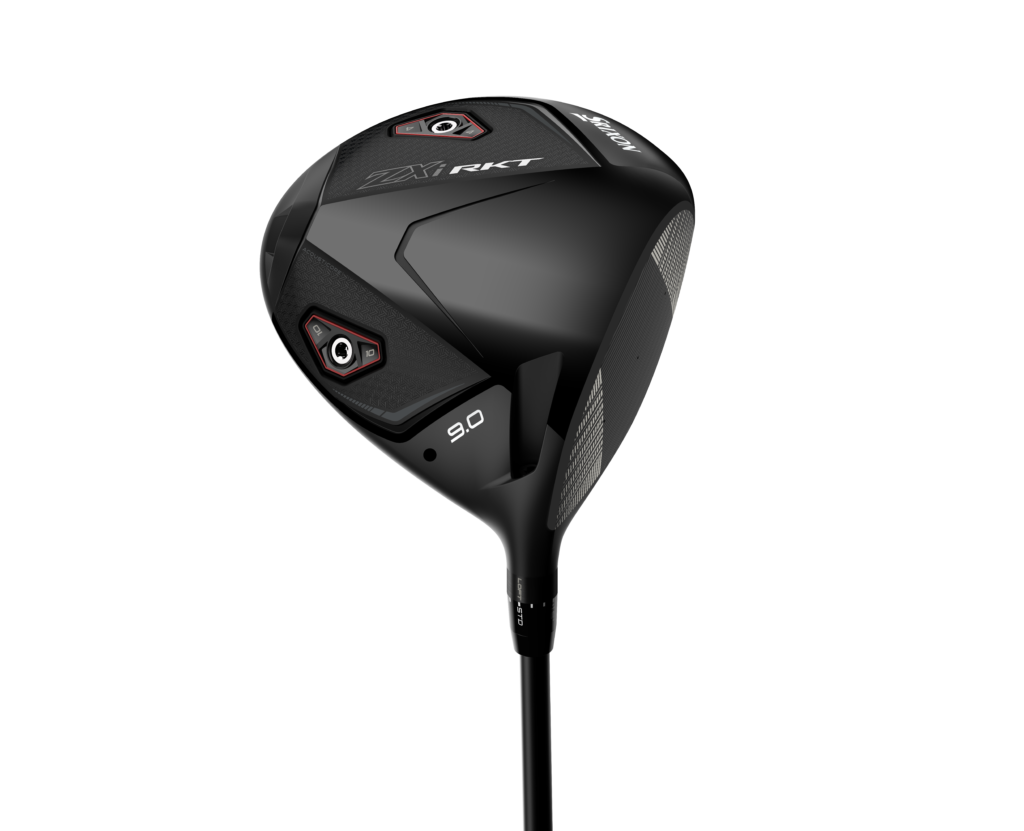
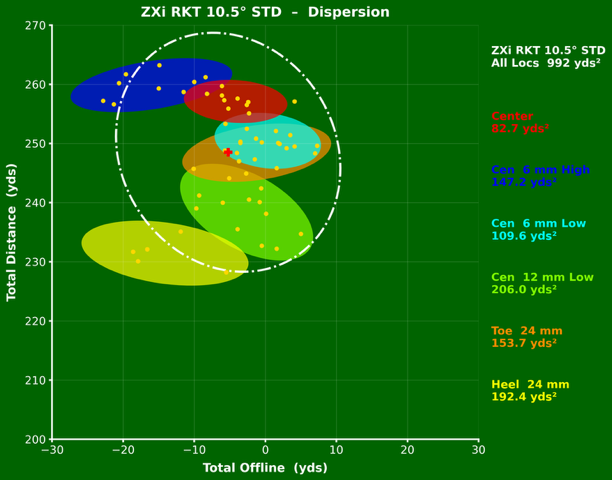
Compared with the outgoing ZXi, ball speed was essentially unchanged, but spin dropped by 302 rpm. Carry increased one yard, total distance increased 6.2 yards, and the center dispersion area tightened from 104.0 to 82.7 square yards — an improvement of approximately 20.5%.
That is exactly the kind of evolution we like to see.
It isn’t necessarily about chasing another mile per hour from the middle of the face. It’s about controlling what happens to the golf ball more effectively.
The Spin Story Might Be the Most Interesting Part
Distance is easy to market.
Consistency is much more interesting to fit.
Our robot testing doesn’t stop with a perfect center strike. We deliberately move impact around the face to understand what happens when a golfer doesn’t hit the middle.
That’s where the RKT family begins to tell a bigger story.
The impact-location plots on page two of our testing compare the previous ZXi family directly against the corresponding RKT models across center, high, low, toe and heel strikes.
We’re looking beyond simply asking, “Which one went farthest?”
We want to know:
How much does spin move? How much distance disappears? How much does direction change? And how predictable is the head when impact moves?
That consistency across the face is one of the strongest characteristics we saw from the new family.
For fitting, predictability matters enormously. A driver producing an incredible center strike but radically different launch conditions when impact moves isn’t necessarily the best driver for a golfer.
The tighter we can keep those performance windows, the more useful that driver becomes.
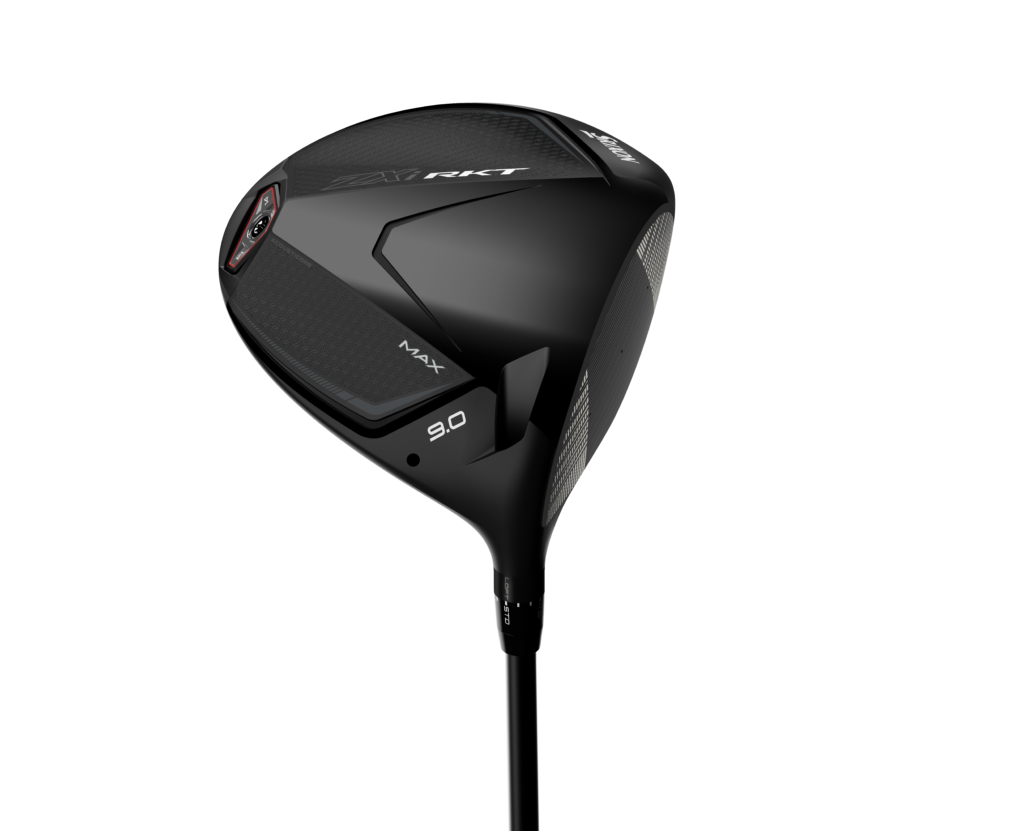
RKT MAX: Srixon Pushes Forgiveness Further
The RKT MAX occupies the other end of the spectrum.
Our measurements put its MOI at 5,577 — 6.8% higher than the previous ZXi MAX and easily the highest of the three new heads. It also has the deepest measured CG at 1.032 inches.
Its weighting system gives the fitter another useful lever, allowing us to influence forgiveness and swing weight depending on the player’s needs.
And the launch conditions changed substantially.
Against the previous ZXi MAX, the new RKT MAX launched 2.2° higher, spun 83 rpm less and carried 7.7 yards farther, despite actually producing 0.3 mph less ball speed in our center-strike test.
That’s important.
The additional distance wasn’t simply coming from more speed.
Srixon changed how the head delivered that speed.
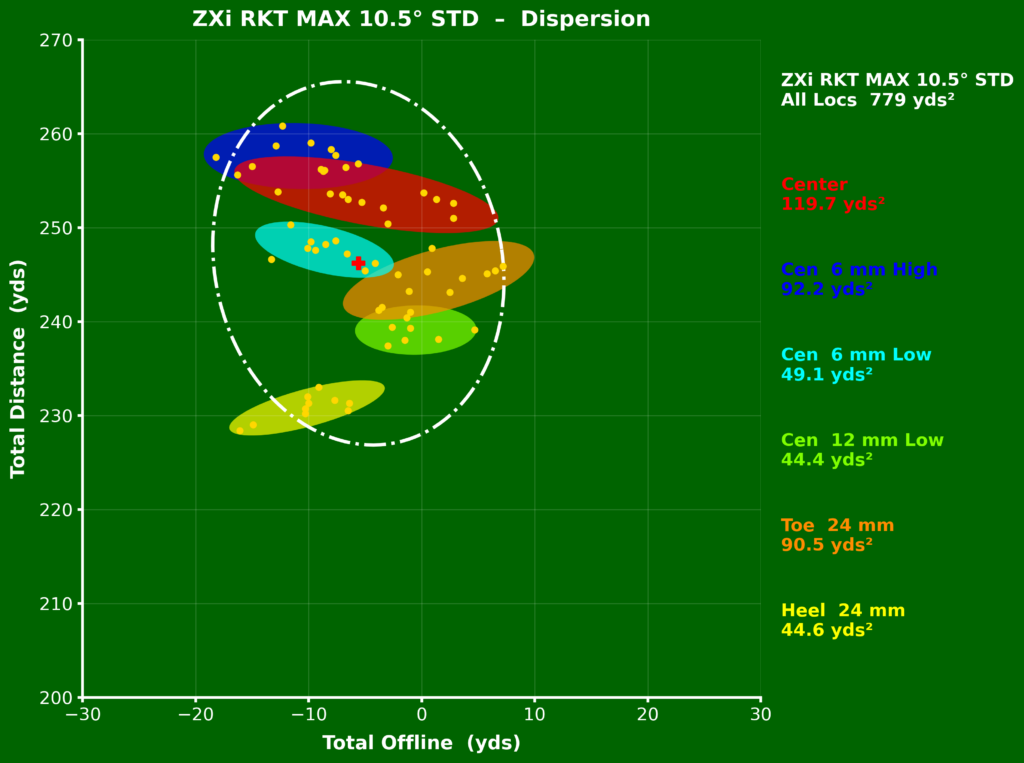
One caveat is worth highlighting: its center-strike dispersion ellipse was larger in this particular robot sample — 119.7 square yards versus 63.0 for the previous MAX — despite the significant MOI increase.
That’s exactly why we don’t want to judge a driver from one specification or one metric.
MOI tells us something.
Ball speed tells us something.
Spin tells us something.
The complete picture tells us whether we want to fit it.
How Do RKT, RKT LS, and RKT MAX Compare?
At 95 mph, the differences are remarkably clear.
| 95 MPH Robot Test | RKT LS | RKT | RKT MAX |
| Ball Speed | 139.3 mph | 139.0 mph | 137.5 mph |
| Efficiency | 1.47 | 1.46 | 1.45 |
| Launch | 10.4° | 10.6° | 12.2° |
| Spin | 1,813 rpm | 2,171 rpm | 2,530 |
| Carry | 226.1 yds | 229.4 yds | 230.1 yds |
| Total | 257.0 yds | 257.1 yds | 253.5 yds |
The progression is almost exactly what you’d want from a three-driver fitting family.
RKT LS: lowest spin, flatter flight, maximum efficiency.
RKT: balanced launch and spin with excellent distance.
RKT MAX: highest launch and spin with the greatest measured MOI.
Same family.
Three genuinely different tools.
And They Look Exceptionally Good
Numbers aren’t the entire fitting.
A golfer still has to want to put the club behind the ball.
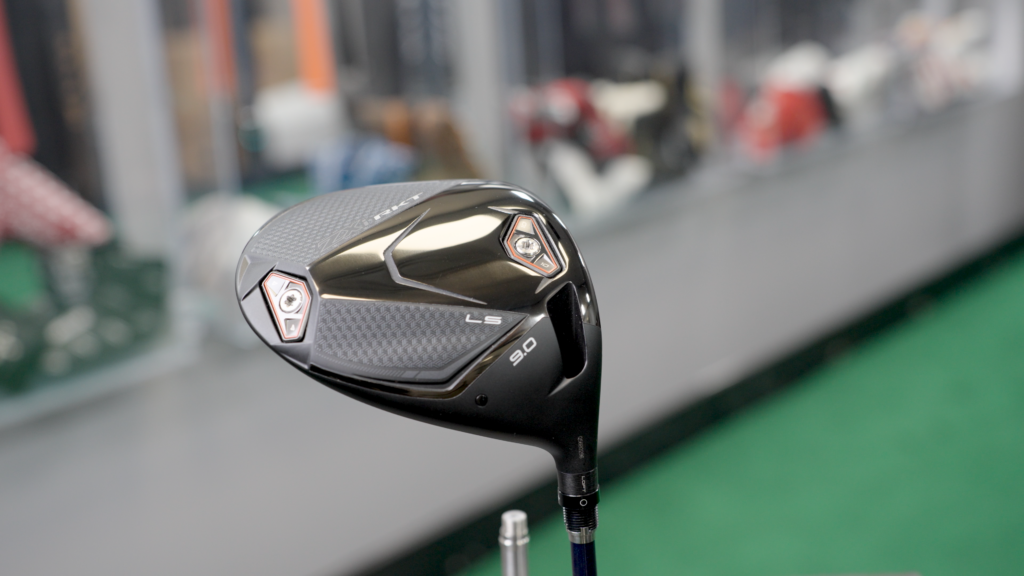
Srixon has kept the RKT family incredibly restrained visually. In a driver market increasingly filled with complicated crowns, aggressive graphics and technology callouts, these heads feel refreshingly simple.
Black. Clean. Modern.
The three heads clearly belong together without looking like Srixon needed to cover every surface with a technology story.
That matters more than people sometimes think.
Confidence at address is part of fitting. Shape, face presentation, sound and feel all influence whether a golfer believes they can hit a particular driver.
And in person, these are some of the best simple-looking drivers currently on the market.
Five Things We Learned From Testing the Srixon RKT Drivers
1. The LS Is More Than Just a Low-Spin Head
The combination of 1,813 rpm spin at 95 mph, a shallow 0.65-inch CG and front-to-back adjustability makes RKT LS an extremely interesting tool for higher-spin deliveries. Its substantial carry improvement versus the previous LS was one of the standout results of the test.
2. The Standard RKT Could Be the Sweet Spot
It doesn’t dominate one particular specification. That’s precisely why we like it.
Good speed. Manageable spin. Strong distance. Improved center dispersion. Heel-to-toe adjustability.
This could fit a lot of golfers.
3. MAX Isn’t Simply a Bigger Version of RKT
With 5,577 MOI, a 1.032-inch CG depth and substantially higher launch, MAX occupies a genuinely different performance window.
That’s exactly what a fitting matrix needs.
4. Srixon Has Improved Performance Without Simply Chasing Ball Speed
On center strikes, the ball-speed differences versus the previous generation were tiny.
Yet the new standard RKT finished 6.2 yards longer, RKT LS 9.5 yards longer, and RKT MAX 8.3 yards longer in the 95 mph test.
Better launch conditions can be every bit as valuable as more speed.
5. All Three Earned Their Place in Our Fitting Matrix
Ultimately, that’s the biggest takeaway.
We don’t need another driver because another driver exists.
We need products that create meaningfully different performance options for golfers.
The RKT LS, RKT and RKT MAX do exactly that.
The Cool Clubs Take
RKT LS gives us low spin and front-to-back CG control.
RKT gives us a balanced performance window with heel-to-toe adjustability.
RKT MAX pushes MOI, launch and forgiveness while giving us additional control over the build and swing weight.
Combine that versatility with strong robot numbers, encouraging performance across different impact locations and some of the cleanest aesthetics we’ve seen this year, and this becomes a very easy family to add to the Cool Clubs fitting matrix.
But robot data only tells part of the story.
Want to See What Happens When a Golfer Hits Them?
In our full YouTube review, Jack takes the RKT LS, RKT and RKT MAX into the fitting bay to see how the differences we measured on the robot translate to a real golf swing.
We go deeper into the numbers, compare the three heads and start answering the question that ultimately matters:
Which Srixon RKT should you actually play?
The Robot Data
How do the new Srixon ZXi RKT Drivers perform when they are hit off of different parts of the face? We put them to the test on our robot to see just how well these drivers stack up.
RKT MAX 10.5°
RKT CORE 10.5°
RKT LS 10.5°